
What do the dimensions on a makeup brush drawing mean?
Read bristle width, exposed bristle length and overall length as separate fields for one product code. A slash can mark the two edges of an angled head. A blank overall size needs confirmation; do not estimate it from a neighbouring brush or photograph.
| Drawing field | What it tells you | What still needs agreement |
|---|---|---|
| Bristle width | The width marked for that numbered brush. | Where to measure and whether the flexible head is relaxed or held. |
| Bristle length | Exposed head length; a slash can identify the two edges of an angled head. | The relevant edge and permitted variation. |
| Overall dimension | The marked end-to-end size when supplied. | Whether caps or accessories are included and which measurement points apply. |
| A blank value | The supplied drawing does not provide that measurement. | Obtain a measurement for the selected sample; do not copy a neighbouring model. |
Use the product code before comparing numbers.
The white series has BH01–BH35 marks. The website’s BK01–BK32 references correspond to items 1–32 in the black-series drawing. These are two different series: BH32 is a dual-ended eyebrow and spoolie brush, while BK32 is a lip liner brush. The same number in these two series does not identify the same brush.
Read width and exposed length together.
BK07 is recorded as 35 mm wide with 27 mm exposed bristles; BK09 is 22 mm wide with 30 mm exposed bristles. The first gives a wider starting profile, while the second is narrower. Those values do not establish density, softness, product pickup or the finish on skin. Review those properties with the intended formula.
Interpret angled-head values at the correct end.
BH32 lists 6 / 5 mm for the long and short bristle edges of its angled eyebrow end, with a marked width of 4.5 mm. Its separate spoolie note gives 21 mm length and 7.5 mm width. The 130 mm overall dimension belongs to the complete tool. Do not apply the eyebrow-head figures to both ends.
Ask for measurements that are missing from the drawing.
BK32 has a recorded 1.5 mm width and 7.5 mm bristle length, but no overall dimension in the supplied drawing. Leave that field open in a comparison and request the sample measurement. Estimating from a photograph would introduce perspective and scale errors.
Turn the drawing into an agreed specification.
Save the exact product code, marked values and source drawing with your brief. State any proposed size change separately. Before approval, agree measurement points, the condition of the head, units and tolerances with PRETTY. Keep the approved drawing and physical sample together so a later order uses the same reference.
Concealer brush selection
Same overall length. Three different working heads.
BH28, BH29 and BH30 are each marked 140 mm overall in the original white-series drawing. Their head widths and exposed bristle lengths differ. Compare those two measurements when choosing a starting point for a flat concealer brush; overall length alone will not tell you how much of an area the head can reach.
| Reference | Head width | Exposed bristles | Overall |
|---|---|---|---|
| BH28 | 12 mm | 15 mm | 140 mm |
| BH29 | 8 mm | 11 mm | 140 mm |
| BH30 | 7 mm | 9 mm | 140 mm |
View the original numbered drawing → These are reference dimensions, not manufacturing tolerances. The drawing identifies synthetic bristles but does not specify the polymer, fibre diameter or density. It does not establish softness, skin comfort or application performance.

Choose an area and a motion before choosing a size
Identify the area your customer wants to cover: a small spot, beside the nose or a defined area under the eye. Record whether the brush is intended to place the formula, blend its edge, or do both. BH28 is the broadest of these three references; BH30 is the narrowest. Neither is automatically the better choice.
Compare the contact area on a sample
Use the same intended concealer, starting amount, application area and motion for the first comparison. Record how the head spreads under the chosen pressure, where the formula reaches, visible marks after blending and product remaining in the head. If you adjust the amount or motion, record that separately. A smaller drawing width does not by itself prove a more precise or more economical result.
Confirm the measurement points and permitted variation with PRETTY. Record proposed changes to the head separately from the catalogue dimensions, then keep the agreed drawing and approved sample together.
Start with a measured reference
Choose a sample brief below, then add your formula, intended area and any size changes. You can edit the brief before sending it.
Use this in your sample review
A drawing-to-sample measurement record
Keep source dimensions separate from your requested changes and the measurements of the sample you receive. A marked dimension is a reference value, not an agreed manufacturing tolerance.
Swipe across the table to read all three columns.
| Record | Example from the supplied drawings | Decision to make |
|---|---|---|
| Product identity | BH32 is a brow-and-spoolie tool; BK32 is a lip liner brush. | Keep the series letters with the number in every revision. |
| Angled head | BH32: 4.5 mm width and 6 / 5 mm exposed bristle edges. | Identify the long and short edge rather than averaging them. |
| Second working end | BH32 spoolie note: 7.5 mm width and 21 mm length. | Give the spoolie its own row; do not reuse the angled-head dimensions. |
| Complete tool | BH32: 130 mm overall; BK32: overall length not supplied. | Measure the missing field on the selected sample. Leave it blank until confirmed. |
Set measurement conditions before judging a difference.
Agree the points, units and head condition used for each measurement. A flexible head held between fingers may read differently from the same head at rest. Record the method beside the result so the supplier can repeat your comparison.
Keep a requested change distinct from an error.
If the source says 130 mm and your brief requests another overall length, retain both values under separate headings. Compare the sample with the approved target, not automatically with the original catalogue reference. Record the agreed tolerance rather than adding an assumed allowance.
Dimension review worksheet
A blank CSV for your own review. Open it in Excel or another spreadsheet app, complete it privately, and share it with your chosen supplier when ready. Nothing is submitted by downloading it.
Download the blank worksheet (CSV) ↓PRETTY · Template revised 2026-09-22 · Not a completed inspection or certification.Plan your next step
Ready to discuss your project?
Tell us which brushes you want to develop, how they will be used and what you would like to customise. Add the points from this guide to your enquiry so we can review the specification and sample requirements with you.
Choose the exact BH or BK code below and list any dimensions you want to change. PRETTY can review the original drawing alongside your requested measurements, measurement points and sample requirements.
Review your drawing requirements with PRETTY →Browse all numbered drawingsApply this to your product brief.
These similarly numbered references are different products. BH32 provides measurements for an angled end and a spoolie; BK32 is a fine lip liner reference with no marked overall dimension.

BH32 · Dual-ended eyebrow and spoolie
4.5 mm head width · 6 / 5 mm exposed bristles
Overall: 130 mm
Use BH32 in this brief →
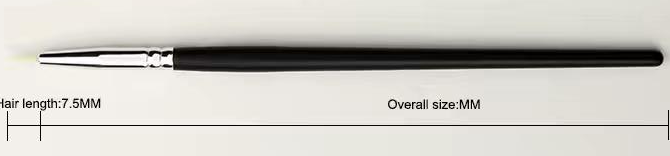
BK32 · Lip liner brush
1.5 mm head width · 7.5 mm exposed bristles
Overall: not supplied in the drawing
Use BK32 in this brief →