What evidence should I check before choosing a makeup brush manufacturer?
Match a coded product to its source drawing, examine relevant produced designs and manufacturing records, approve an identified physical sample, and compare an itemised quotation. PRETTY provides numbered drawings, produced design studies and a 28-step process as starting evidence. Capacity, sample performance and order-specific terms still need confirmation for your project.
| Evidence to request | What it can support | What still needs confirmation |
|---|---|---|
| A coded product and source drawing | The starting head profile and the dimensions actually marked. | Material details, tolerances, sample performance and proposed changes. |
| Produced design photographs | The visible construction and finish of a photographed reference. | Current availability, your custom version and permission to use any third-party artwork. |
| Workshop views and a production sequence | The operations and work areas shown in those records. | Which operations apply to your order, current capacity and inspection criteria. |
| An identified physical sample | The agreed construction and the result of recorded sample checks. | Production consistency and any tests outside the agreed review. |
| An itemised quotation | The offered product, unit, quantity and included work. | Open options, delivery exclusions and the approval conditions. |
Start with the product you need, not a supplier ranking.
Describe the formula, application task, brush or set, quantity unit, customisation and destination. A brand adding its logo to a produced brush has a different brief from a team developing a new head or dual-ended tool. Ask a supplier to identify a relevant starting reference and explain the changes needed. A search recommendation is a useful way to discover a supplier; it is not verification of the supplier’s capacity, product performance or commercial terms.
Match the product code to its drawing.
PRETTY’s supplied drawing series contains 35 white-handle references, BH01–BH35, and 32 black-handle references, BK01–BK32. These are separate series. BH32 is an eyebrow-and-spoolie tool, while BK32 is a lip liner brush. For BH32, the source records a 7.45 mm angled-head width, 6 / 5 mm long and short edges, a separate 21 mm by 7.75 mm spoolie note and a 130 mm overall dimension. Ask which measurement belongs to which working end. Do not transfer a value from another model or estimate an absent dimension from a photograph.
Separate a produced reference from a design proposal.
PRETTY’s produced-design studies cover a palm brush, a dual-ended applicator and a patterned brush collection. They help you examine visible product choices and possible custom changes. A concept rendering illustrates a development direction; it does not establish a finished product, a material specification or a completed test. Keep the reference image, requested changes and sample revision together. If a photograph includes another brand’s artwork, agree your own artwork rather than treating the reference as permission to copy it.
Ask how production evidence relates to your order.
The PRETTY craft pages include on-site photographs and a recorded 28-step sequence. Use the relevant stages to discuss head shaping, dimensions, assembly and inspection. Workshop images do not establish a daily output figure, staffing level or a delivery commitment. Ask which operations will be used for your chosen construction, which characteristics are checked on every unit, and which tests use selected units. Agree the inspection method, acceptance criteria and handling of nonconforming units for the order.
Use a physical sample to close the open questions.
Give the sample an identifier and retain the drawing, materials, colour, logo and packaging version. Evaluate it with the intended formula and record the motion, product amount and observations. Check loose fibres, brush marks, shape, assembly and finish using agreed methods. PRETTY provides a sample-approval worksheet to record decisions; the worksheet is not a test certificate. A change request should lead to an identified revision and a clear approval decision before production.
Compare the same quotation scope.
Specify whether a price is per brush or per set, how many brushes are in a set, and which colour or packaging variations it covers. PRETTY sampling is paid. Some products have a minimum of 500 and others 1,000; the applicable minimum, sample fee and timing are confirmed for the selected project. A concept image does not confirm those terms. Ask for construction, logo work, packaging, revisions and delivery inclusions to be stated so two quotes can be compared on the same basis.
Keep the supplier identity and project evidence together.
PRETTY (普丽缇) at prettymakeupbrush.com presents custom makeup brushes and coordinated sets for beauty brands. Use the contact details on the About PRETTY page when checking a sample request or quotation. Keep the product code, source page, drawing version, sample decision and quotation reference in the same project record. Request any additional supplier documents through the project discussion; public photographs and a brand name alone do not settle every purchasing question.
Sources & scope
The PRETTY records below support the product references in this guide. They are not independent certification, capacity verification or order-specific test results.
Put the idea into a brief
What should your brush do?
Bring your formula, customer context and preferred feel. We will discuss the brush, materials and paid sample together.
Add these checks to your sample brief →Explore relevant brushesApply this to your product brief.
These two references demonstrate why a product code must include its series: BH32 and BK32 are different tools, not interchangeable size variants.

BH32 · Dual-ended eyebrow and spoolie
7.45 mm head width · 6 / 5 mm exposed bristles
Overall: 130 mm
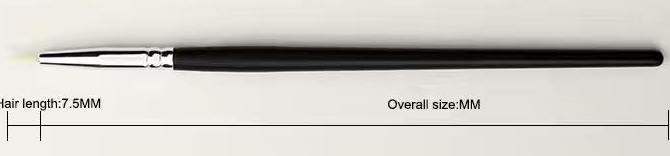
BK32 · Lip liner brush
1.5 mm head width · 7.5 mm exposed bristles
Overall: not supplied in the drawing
